02:10
Ben texts. The office is closed.
Tenants keep texting and emailing as they do today, to one number and one address. There is no app for them to install.
There is no heat in my unit and it is freezing
FixTriage answers every repair text at once, calls your people until one of them takes the emergency, and drafts the vendor text for you to approve. Built for BC rental managers with 20 to 150 doors.
In development. The demo is complete and clickable, with invented people. No live accounts yet.
“There is no heat in my unit and it is freezing”
Be Lee. Press it.
The tenant gets a fixed safety reply before anything is decided. No AI writes it, so it goes out even if the AI is down.
First on call, backup, owner, then our operators. Only a person taking it ends the calls. Never a timer.
The vendor text is drafted with the address, unit and photos. Nothing goes out until you approve those exact words.
02:10
Tenants keep texting and emailing as they do today, to one number and one address. There is no app for them to install.
There is no heat in my unit and it is freezing
02:10, seconds later
The same fixed words every time, chosen by the clock and the rules. After hours they also say how to raise the alarm.
02:10 to 02:15
A call and a text together, with a second try at 2 minutes. At 5 minutes it moves to the next person. If both channels fail, it moves at once.
02:16
Press 1 on the call, or one tap on the link. No sign-in. Lee then has 30 minutes to record what happened. With nothing by 45, the calls start again.
02:19
The vendor list is yours, in your order. If the vendor does not say yes in 10 minutes, people are called again with the next vendor drafted. The system never picks a second vendor alone.
Example Coast Rentals: EMERGENCY repair at 1200 Example St, unit 204. There is no heat in my unit and it is freezing. Reply YES to confirm or NO to decline.
YES
09:00
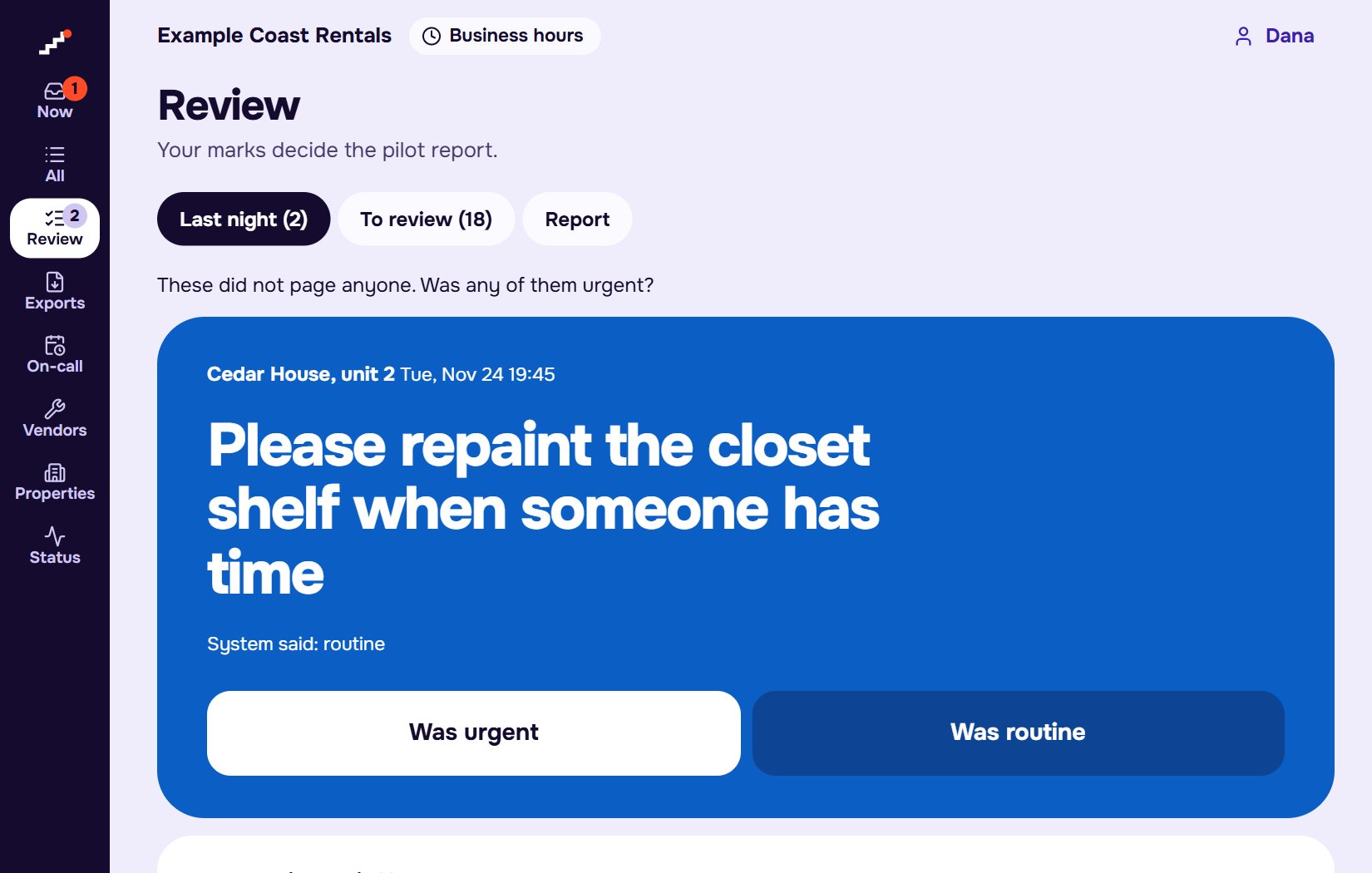
Who was called, who took it, what was sent and when. Anything that did not page anyone is listed so you can say whether it should have.
These are the product’s own rules, running in your browser. Nothing you type is sent anywhere.
Rules will miss some wordings. That is why they are not the safety net: after hours every reply tells the tenant to text URGENT, anything unclear calls a person, and you check the quiet ones each morning. The AI model is not run on this page.
Fifteen repair requests become fifteen cards, most urgent first. Decide with a button or the 1, 2, 3 keys.
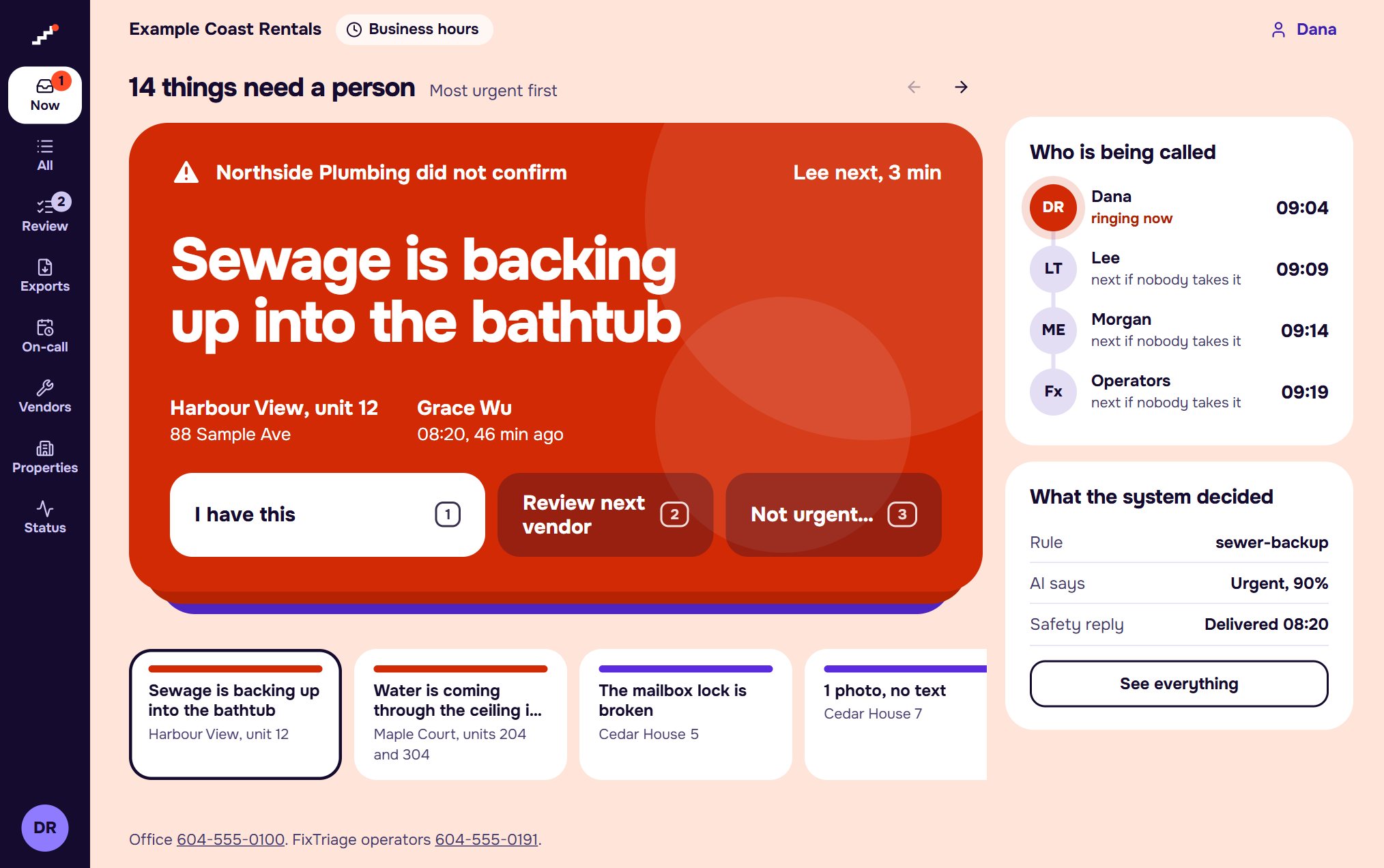
A photo with no words, another language, a vague message: it says “not sure” and asks a person. It is never filed as routine.
Three units report the same flood. You get one incident with three reports. A different unit still calls you until a person says it is the same.
By trade, with after-hours vendors marked. Import a CSV and see a result for every row.
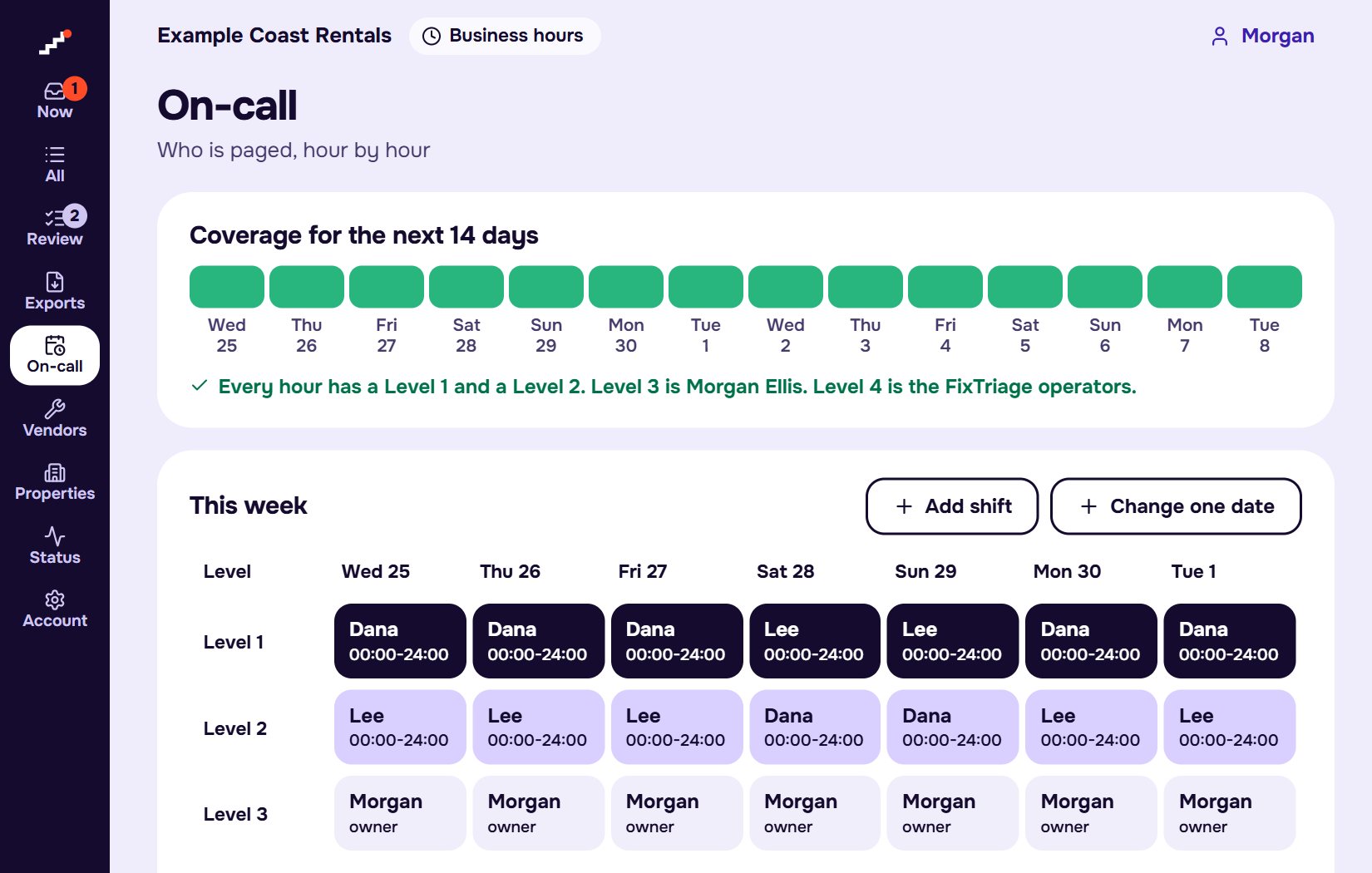
Fourteen days of coverage at a glance. A schedule with a gap cannot be saved, and every phone gets a weekly test call.
If a tenant sent STOP, you are told to phone them, with the number to call.
A daily digest and a CSV of work orders. No migration and no new login for tenants or vendors.
It is not an emergency line. It does not replace the emergency contact number you must give tenants under section 33 of BC’s Residential Tenancy Act, and that number is in every safety reply. It does not take phone calls from tenants, book vendors on its own or handle accounting. It covers British Columbia, and its rules read English; other languages go to a person.
CAD 99
30 live days, your whole portfolio, one text number and one email address
One person you name does the marking, one request at a time. Both sides see the same figures.
Proposed launch prices in Canadian dollars, before tax, paid monthly. 15% less if paid yearly. No setup fee. Requests, messages and users are not counted. The pilot is paid when you sign, and the 30 days start with your first live message. You can cancel for a full refund until then.
Helpful but optional: tenant phone numbers and your vendor list.
Your brokerage stays responsible for it under BC’s Personal Information Protection Act. FixTriage holds it for you.
It has not been proven on live traffic yet. The pilot measures it, and one missed urgent case caused by FixTriage returns your fee. After hours, anything the rules or the AI find unclear calls a person, and every reply tells the tenant to text URGENT or phone your emergency number.
An outside monitor watches the service, and a test text runs on our own numbers every 6 hours. A silent carrier fault could go unseen for up to 6 hours and 5 minutes, and a fault on your number alone is not tested. Your emergency phone number does not change, and tenants have it in every reply.
Keep it. FixTriage turns raw messages into filled-in work orders and exports a CSV. If your software already answers tenant texts after hours at no extra cost, you probably do not need this.
Then this is not the right tool yet. Calls to the text number are forwarded to your emergency contact. Keep your answering service if most emergencies come by voice.
It proposes. Fixed rules set the floor, the highest answer wins, and only a signed-in person can lower it, with a reason you will see the next morning.
The first one has it. The second is told who took it and when.
Not yet. The safety rules are written and tested in code, and the demo shows every screen. Live texting, calls and accounts are not switched on.
Ten guided walk-throughs, from a first text to a closed work order. Nothing to install and no account.
Open the live demo